Building Production-Ready Agentic AI Systems for Enterprise Software Delivery
Lessons from building production-grade agentic AI systems for enterprise delivery. Moving beyond POCs to reliable, scalable AI engineering workflows.
Khurram Bilal
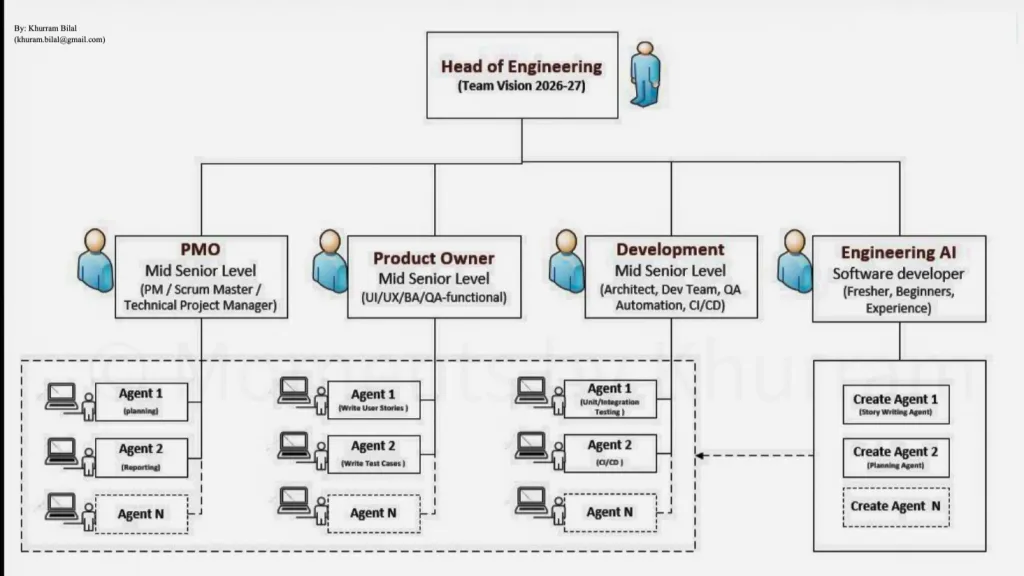
Episode 1: From POCs to Production – What I Learned Building Agentic Engineering Workflows
1. Context: The Gap Between Potential and Reality
Over the last year, we’ve all seen how rapidly AI capabilities especially Large Language Models (LLM) have advanced. From code generation to reasoning tasks, the progress has been significant and genuinely impressive.
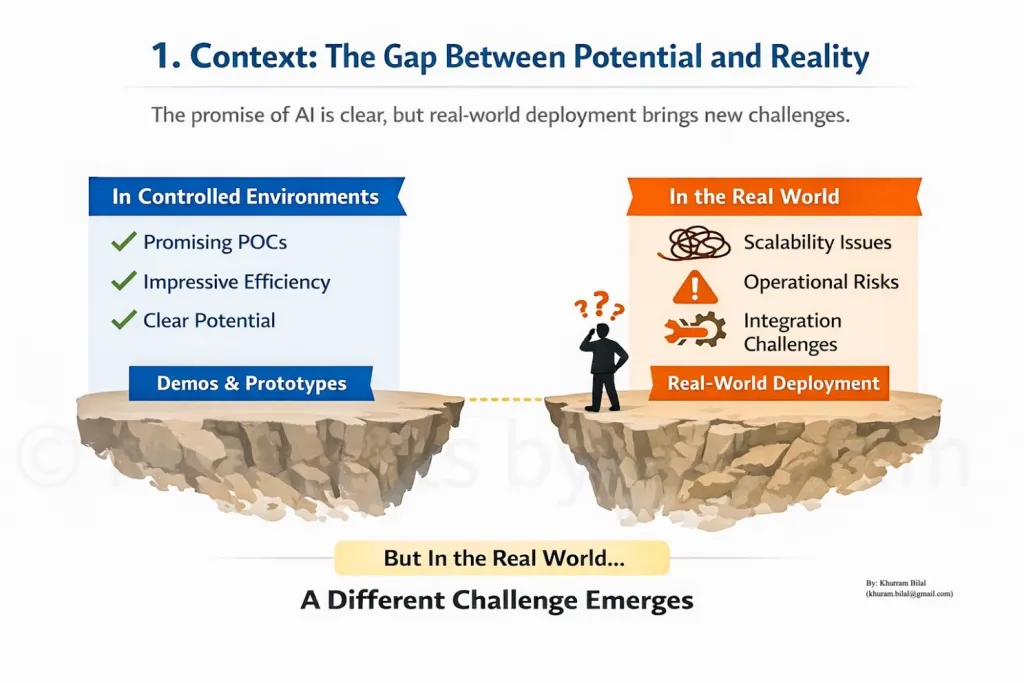
In controlled environments:
- Proof of Concepts (POCs) look promising
- Concept validations show strong efficiency gains
- Early experiments demonstrate clear potential
However, once you move beyond demos and prototypes, a different challenge emerges:
How do you make these capabilities reliable, repeatable, and production-ready within real engineering teams?
This is the gap I’ve been working on over the past few months.
2. My Starting Point: Encouraging Experiments, Limited Impact
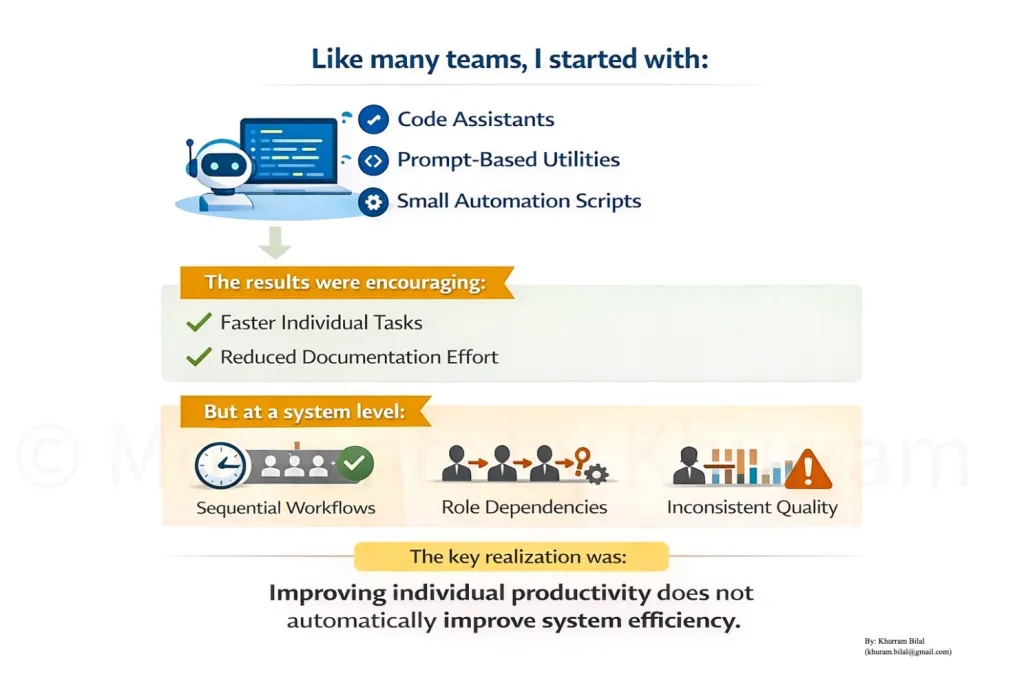
Like many teams, I started with:
- Code assistants
- Prompt-based utilities
- Small automation scripts
The results were encouraging:
- Faster individual task execution
- Reduced effort for documentation and boilerplate work
But at a system level:
- Workflows remained sequential
- Dependencies between roles still caused delays
- Output quality was inconsistent
The key realization was:
Improving individual productivity does not automatically improve system efficiency.
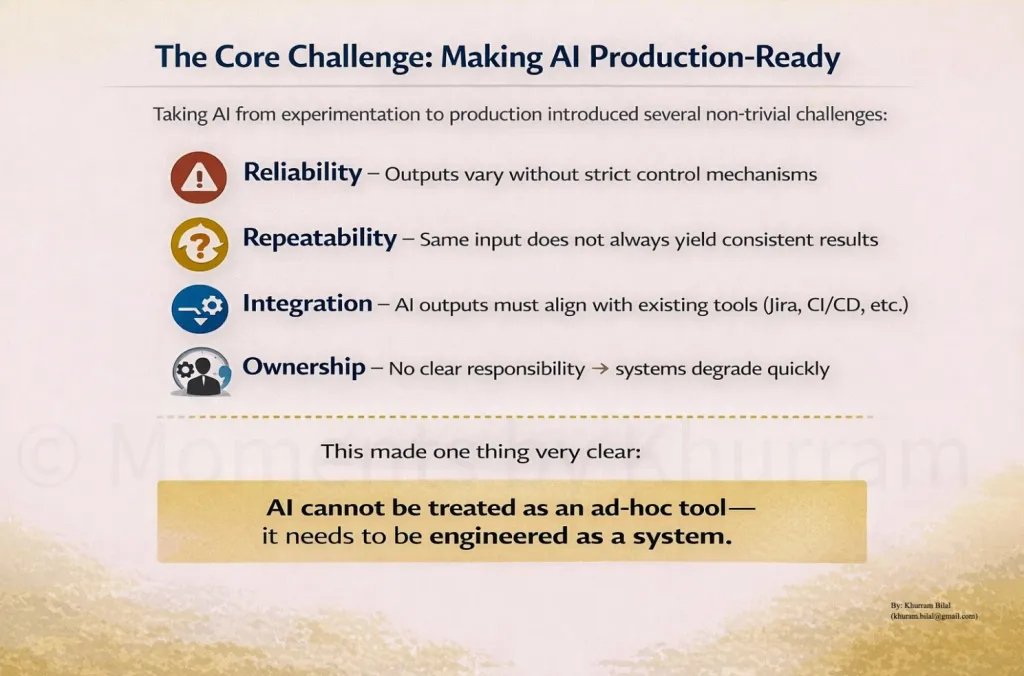
3. The Core Challenge: Making AI Production-Ready
Taking AI from experimentation to production introduced several non-trivial challenges:
- Reliability: Outputs vary without strict control mechanisms
- Repeatability: Same input does not always yield consistent results
- Integration: AI outputs must align with existing tools (Jira, CI/CD, etc.)
- Ownership: No clear responsibility → systems degrade quickly
This made one thing very clear: AI cannot be treated as an ad-hoc tool it needs to be engineered as a system.
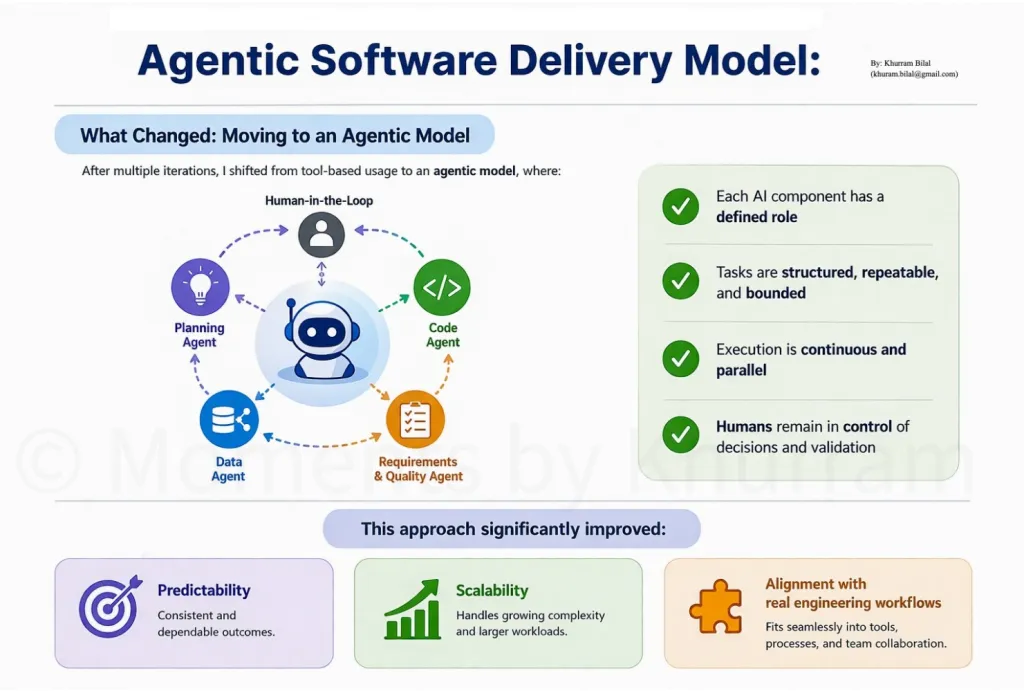
4. What Changed: Moving to an Agentic Model
After multiple iterations, I shifted from tool-based usage to an agentic model, where:
- Each AI component has a defined role
- Tasks are structured, repeatable, and bounded
- Execution is continuous and parallel
- Humans remain in control of decisions and validation
This approach significantly improved:
- Predictability
- Scalability
- Alignment with real engineering workflows
5. The Operating Model That Emerged
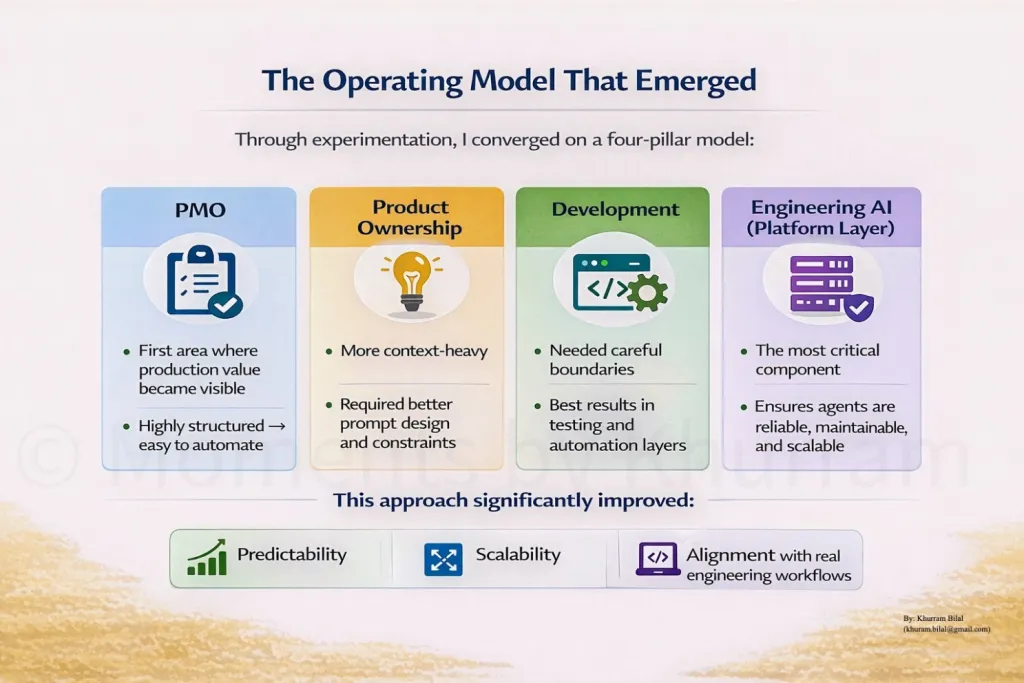
Through experimentation, I converged on a four-pillar model:
PMO
- First area where production value became visible
- Highly structured → easy to automate
Product Ownership
- More context-heavy
- Required better prompt design and constraints
Development
- Needed careful boundaries
- Best results in testing and automation layers
Engineering AI (Platform Layer)
- The most critical component
- Ensures agents are reliable, maintainable, and scalable
What I’ve Learned So Far (Practical Insights)
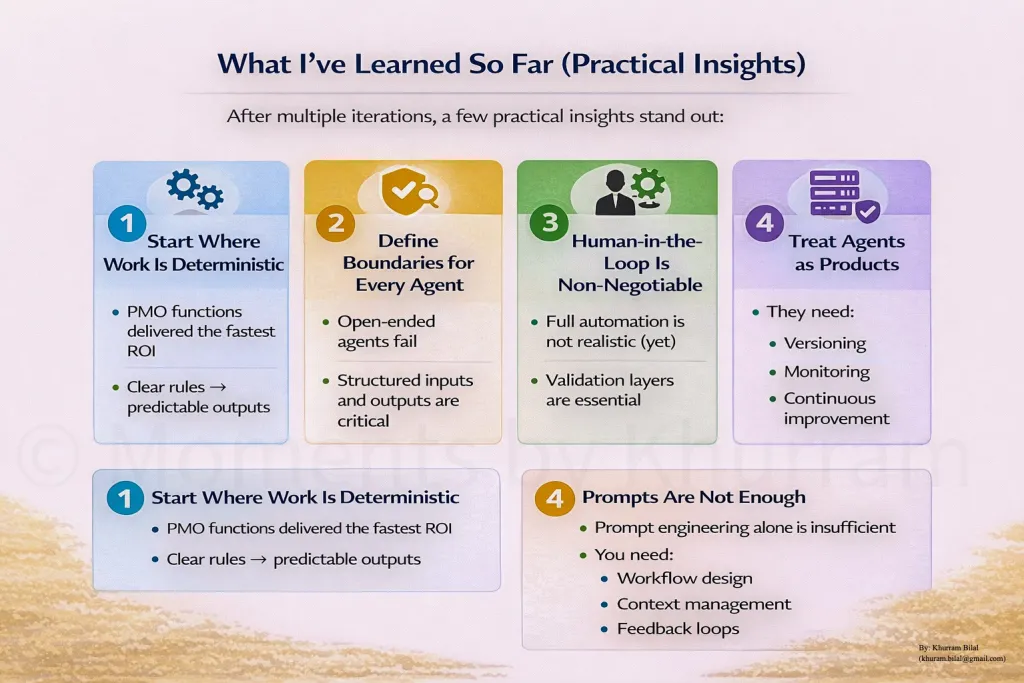
After multiple iterations, a few practical insights stand out:
1. Start Where Work Is Deterministic
- PMO functions delivered the fastest ROI
- Clear rules → predictable outputs
2. Define Boundaries for Every Agent
- Open-ended agents fail
- Structured inputs and outputs are critical
3. Human-in-the-Loop Is Non-Negotiable
- Full automation is not realistic (yet)
- Validation layers are essential
4. Prompts Are Not Enough
- Prompt engineering alone is insufficient
- You need: Workflow design Context management Feedback loops
5. Treat Agents as Products
They need:
- Versioning
- Monitoring Continuous
- Improvement
What’s Next
In the next episode, I’ll go deeper into the Product Ownership layer, the starting point of any software development lifecycle. We’ll explore why and how this area can be leveraged efficiently using an agentic approach.
We’ll cover:
- What types of agents are most effective in Product Ownership (e.g., requirement, backlog, prioritization agents)
- How these agents collaborate to structure and refine work
- How backlog creation, planning, and alignment can be systematized
- Where human decision-making fits in the loop
- The impact on clarity, speed, and delivery outcomes
Closing Thought
AI capabilities have clearly reached a new level.
POCs prove the potential but the real challenge and opportunity is this:
Turning that potential into production-ready, reliable systems that teams can depend on every day.
This is what I’ve been exploring from some time and what I’ll continue to break down in this series.
Read more :

Fractional CTO, Tech Sprinter
LinkedIn →Want to talk through this for your company?
We work with a small number of startups and scale-ups at a time. If this resonated, let's have a conversation.
Send a message