New Curriculum for Software Engineers in the Agentic Era
Not syntax, not algorithms. The four disciplines that decide whether your organization gets real value from AI or just generates more code, faster.
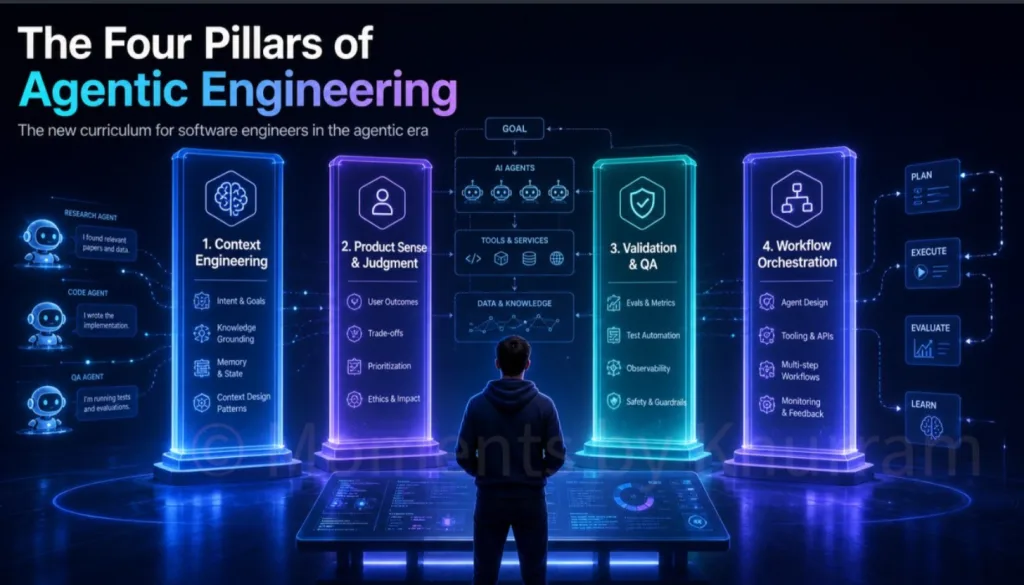
Not syntax. Not algorithms. The four disciplines that decide whether your org gets value from AI or just generates more code, faster.
Where We Are in the Series
In Episode 1, I wrote about what it actually takes to move agentic AI from POCs to production and why individual productivity gains rarely translate into system-level outcomes. In Episode 2, we looked at the Product Ownership layer how intent, requirements, and acceptance criteria become first-class inputs into agentic workflows. In Episode 3, we walked through the autonomous QA loop the shift from script-followers to strategy-makers.
Each episode answered a different version of the same question: how does work change when agents are doing the doing?
This Episode 4, answers a more uncomfortable one.
If agents are writing the code, running the tests, and filing the tickets, what exactly is the engineer’s job
The honest answer is: the job didn’t disappear. It moved.
It moved up the stack, into four disciplines that almost no engineering team has formally trained for, hired for, or measured against.
I’ve started calling them The Four Pillars of Agentic Engineering:
- Context Engineering
- Product Sense & Judgment
- Validation & Quality Assurance
- Workflow Orchestration
These are the new core curriculum. Not syntax. Not algorithms. Not framework-of-the-month. The skills that decide whether agentic AI becomes a force multiplier or a very expensive autocomplete. Let’s go through each one.
Pillar 1: Context Engineering
Your prompt and your context window are your levers.
The first thing you learn when you start building real agentic systems is that the model is rarely the bottleneck. The context is.
Two engineers can use the same model, the same tools, and the same task and get wildly different output. The difference isn’t intelligence. It’s what they put in front of the agent before they asked.
Context engineering is the discipline of deliberately curating:
- What the agent knows : repo state, prior decisions, domain constraints, business intent
- What the agent can see : files, schemas, logs, tickets, screenshots, traces
- What the agent should ignore : stale docs, dead code paths, irrelevant noise
- What the agent should remember : across turns, across sessions, across teams
In the pre-agentic era, “good prompting” was treated as a soft skill. In the agentic era, context engineering is a hard engineering discipline with patterns, anti-patterns, observability, and failure modes of its own.
Most teams discover this the hard way. They give an agent a vague task on a 2-million-line monorepo and are shocked when it hallucinates a function that doesn’t exist. The agent didn’t fail. The context did.
What this looks like in practice:
- Treating prompts and context bundles as versioned artifacts, reviewed like code
- Building context retrieval pipelines: not just RAG, but task-specific retrieval shaped by the work being done
- Designing memory boundaries : what persists, what resets, what’s scoped to a session
- Measuring context efficiency : how much of the window is signal vs. noise
If your org doesn’t have anyone whose job it is to engineer context, your agentic outputs are accidents. Sometimes good ones. Mostly not.
Pillar 2: Product Sense & Judgment
The agent fills the blanks. You decide what is worth building.
This is the pillar most engineering leaders underestimate and it’s the one that’s about to matter most.
When the marginal cost of generating a working implementation drops to near-zero, the scarce resource isn’t building. It’s deciding what to build, what to keep, and what to throw away. That’s Judgement.!
Judgement is the senior engineer who looks at a perfectly functional 400-line PR and says, “This shouldn’t exist. We don’t need this feature.” It’s the architect who chooses the boring solution because it knows what the exciting one will cost in two years. It’s the staff engineer who can tell you, in thirty seconds, why a generated abstraction is wrong even though every test passes.
Agents are extraordinary at producing plausible options. They are terrible at knowing which option is worth shipping in your system, for your users, under your constraints.
What Judgement looks like as a discipline:
- Knowing the difference between correct and right
- Recognizing when an agent’s solution is technically valid but architecturally wrong
- Choosing simplicity over cleverness, even when the agent offers cleverness for free
- Saying “no” or “not yet” to features, to abstractions, to optimizations
- Understanding the long-term cost of code that exists, vs. code that doesn’t
Product. sence used to be the silent superpower of senior engineers hard to teach, hard to measure, easy to undervalue. In an agentic org, it becomes the most leverage-dense skill on the team.
The implication for hiring and career ladders is significant: we have spent decades rewarding people for output. We’re entering an era where the highest-paid engineers will be rewarded for discernment.
Pillar 3: Validation & Quality Assurance
The agent is fallible. You are the last line of defense.
Every agent fails. Quietly, confidently, and often in ways that look exactly like success.
This is not a flaw to be eliminated. It is a permanent feature of probabilistic systems. The orgs that internalize this build for it. The orgs that don’t get burned by it usually in production, usually under audit.
Validation is the discipline of designing systems where agent output is treated as a hypothesis, not a result, until something or someone has confirmed otherwise.
We touched on this in Episode 3 [https://www.tech-sprinter.com/blog/from-script-followers-to-strategy-makers ] the autonomous QA loop is, fundamentally, an industrial-scale verification machine for application behavior. But verification isn’t just QA’s problem. It runs through every layer of agentic engineering:
- Did the agent change what it said it changed? (diff verification)
- Does the change actually do what the requirement asked for? (intent verification)
- Did it break something it wasn’t supposed to touch? (regression verification)
- Are the assumptions it made about the system still true? (context verification)
- Does the output meet our standards, not just the model’s standards? (QA)
What QA verification looks like in practice:
- Layered checks: automated tests, agent-on-agent review, human-in-the-loop sign-off — proportional to risk
- Trust budgets per agent and per task type, how much autonomy has this agent earned for this kind of work?
- Verifiable artifacts : every agent action produces evidence: diffs, traces, logs, justifications
- Failure-mode libraries : known patterns of agent error, treated like security CVEs
- Replayability : being able to reconstruct why an agent did what it did, weeks later
In a non-agentic org, verification is something QA does at the end. In an agentic org, verification is everyone’s job, all the time, and it’s the core of how senior engineering judgment is expressed at scale.
If your only verification mechanism is “I’ll review the PR,” you do not have a verification strategy. You have hope.
Pillar 4: Orchestration
Multiple agents in parallel. You coordinate.
The first time you successfully run one agent on one task, it feels like magic.
The first time you successfully run seven agents on seven tasks at the same time, on the same codebase, without them stepping on each other, it feels like system design, because that’s exactly what it is.
Orchestration is the new system design.
It’s the discipline of decomposing a unit of work into pieces that agents can execute in parallel, defining the contracts between them, managing shared state, resolving conflicts, and merging the results into something coherent.
If that sounds like distributed systems engineering, that’s because it is. The actors just happen to be reasoning entities instead of microservices.
What orchestration covers:
- Work decomposition : splitting a problem into agent-sized, independently verifiable units
- Coordination patterns : fan-out/fan-in, pipelines, supervisor trees, debate loops, planner-executor splits
- Shared-state management : branches, worktrees, feature flags, scratch spaces so agents don’t clobber each other
- Conflict resolution: what happens when two agents disagree, or produce overlapping changes
- Backpressure and budgets : token budgets, time budgets, retry budgets, escalation paths
- Human checkpoints : where the loop pauses for judgment, and where it doesn’t
The teams getting real leverage out of agentic AI today are not the ones with the best prompts.They’re the ones with the best orchestration patterns, repeatable, observable, debuggable workflows where agents do most of the work and humans intervene at exactly the right moments.
This is where the next decade of engineering tooling will be built. And it’s the pillar where most orgs are flying completely blind.
Why This Is the Curriculum, Not Just a Skillset
Here’s the part that matters at the org level.
Every one of these four pillars used to be a peripheral skill , useful, but not central. Context-shaping was something good engineers did intuitively. Judgement was a vibe. Verification was QA’s job. Orchestration was for distributed systems specialists.
In an agentic org, all four become central, simultaneously, for every engineer.
That has cascading implications:
- Hiring rubrics still optimized for LeetCode and framework trivia are testing for the wrong things. The new interview signals are: how do you frame context, how do you exercise judgement under uncertainty, how do you verify, how do you orchestrate?
- Career ladders built around lines-of-code, ticket throughput, or PR volume will reward exactly the wrong behavior in an agentic org. Output is cheap now. Judgment isn’t.
- Performance reviews need new instruments. “Shipped X features” is a metric for an era that’s ending. “Designed the verification strategy that prevented Y class of regression” is a metric for the era we’re entering.
- Training and L&D budgets are still mostly aimed at syntax, frameworks, and certifications. The actual gap is in the four pillars and almost no formal curriculum exists for them yet.
- Org structure itself shifts. Roles like Context Engineer, Verification Lead, Agent Orchestration Architect aren’t science fiction anymore. They’re emerging job titles in the orgs that are actually shipping agentic systems at scale.
The orgs that re-skill around these four pillars will out-ship, out-quality, and out-hire everyone still optimizing for the old curriculum.
The ones that don’t will spend the next two years confused about why their “AI productivity initiative” isn’t showing up on the P&L while their best engineers quietly leave for places that take this seriously.
What I’ve Learned So Far ?
A few things that have become clearer to me with every iteration:
- The four pillars are not sequential. They’re simultaneous. You don’t graduate from context to product judgment to verification to orchestration. You exercise all four on every meaningful piece of work.
- Tools matter less than disciplines. The frameworks will churn. The pillars will not.
- Senior engineers were already doing all four (implicitly). What’s new is that the bar is now explicit, and it applies to everyone.
- The biggest blocker is not technical. It’s organizational. Most orgs know how to buy tools. Very few know how to redesign their hiring, ladders, and reviews around new disciplines.
- You can’t outsource any of the four. Especially product sense and verification. Those are where your org’s identity lives.
Closing Thought !!!
We started this series with a simple observation: there’s a big gap between agentic AI’s potential and what’s actually showing up in production.
Each episode has been a different angle on closing that gap, production engineering, product ownership, autonomous QA.
This episode is the underlying claim that ties all of them together:
Agentic AI is not a tool you adopt. It’s a discipline you train.
The four pillars: Context, Product sense, Verification, Orchestration , are the new core curriculum for that discipline. The orgs that treat them seriously will compound advantage quarter over quarter. The orgs that treat them as a slide in a strategy deck will keep wondering where the ROI went.
Until next time : pick the pillar where your team is weakest, and start there. That’s almost always the highest-leverage move you can make this quarter.
If this resonated, the earlier episodes are here:
- Episode 1 : Production-Ready Agentic AI Systems
- Episode 2 : From Prompt to Production
- Episode 3 : From Script-Followers to Strategy-Makers
— Khurram Bilal

Fractional CTO, Tech Sprinter
LinkedIn →Want to talk through this for your company?
We work with a small number of startups and scale-ups at a time. If this resonated, let's have a conversation.
Send a message