The AI Augmented Parallel SDLC
A delivery model that replaces the chain of handoffs: discover once, run design, build and QA in parallel, and converge at a single quality gate.
August 23, 2026
A blueprint for shipping faster without losing accountability
By Khurram Bilal
Underneath most delivery processes – whether it is explicit in Waterfall or quietly embedded in many Agile implementations – lies the same fundamental pattern: a chain of handoffs.
The client communicates the vision to the business analyst. The analyst translates it for the designer. The designer passes it to the developer. The developer moves it to QA. Each person waits for the approval, input, or completion of the person ahead of them before moving forward.
The result is a sequential flow where progress depends less on collaboration and more on passing work from one stage to the next.We ran that chain for years, on a live delivery department, before we stopped asking how do we make the chain faster and started asking why is it a chain at all. What follows is the delivery model that came out of that question – the structure, the AI augmentation layered into it, the cultural rule that keeps it from quietly reverting to the old chain, and the results measured running it in production.
The handoff chain problem
A sequential chain incurs two costs, and only one is visible. The visible cost is idle time – at any moment, most of the team is blocked behind someone else’s sign-off. The hidden cost is fidelity loss: understanding degrades at every handoff, so QA ultimately verifies a fourth-hand account of what the client actually meant.
The usual remedy – heavier documentation, stricter sign-offs – makes the chain slower without fixing the loss, because the loss is a property of serialized handoffs, not of document quality. Sequential delivery persists because it feels safe: every phase starts from a signed baseline. That safety turns out to rest on three assumptions that were reasonable once and are now false.
Three assumptions that no longer hold
1 – Understanding must be handed off role by role. It doesn’t. Replace the chain’s front end with a single joint discovery session – client, UI/UX, QA, development, and BA, all in the room – governed by one rule: every discipline takes its own notes, through its own lens. Same conversation, zero handoffs, zero fidelity loss.
2 – Development can’t start before requirements sign-off. The rework is real – the conclusion is still wrong. Requirements genuinely evolve as they’re examined closely (progressive elaboration). The sequential SDLC doesn’t eliminate that divergence, it just discovers it later – as expensive change requests and UAT findings. Invert the order: start development on the discovery-session understanding, elaborate requirements in parallel. The divergence – a stable 15–20% in practice – gets discovered early, cheap, and budgeted in advance.
3 – Speed, memory, and judgment come from the same humans. Break any role apart: production (writing code, authoring stories, executing tests), project memory (prior decisions, cross-module impacts), engineering judgment (review, correctness, ownership). AI agents now supply production and memory. Only judgment remains scarce, expensive, and irreducibly human.
A process designed for the old cost structure cannot be optimal under the new one. That’s not a criticism of anyone running it. It’s arithmetic.
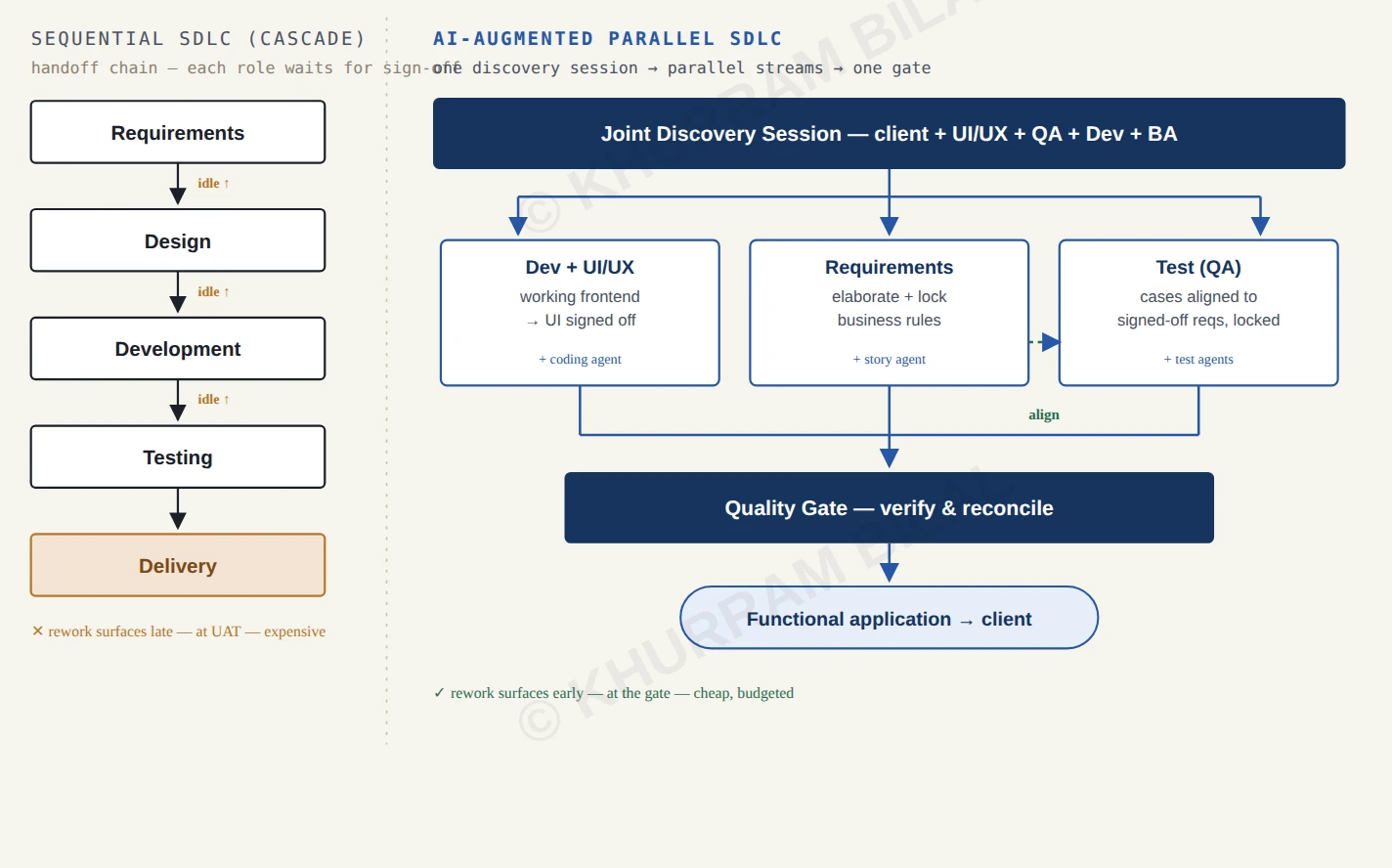
The model: discovery once, three parallel workstreams, one gate
The joint discovery session. The designer and the tester hear the same sentence from the client and extract different implications – one hears a screen flow, the other an edge case; the developer hears a data model, the BA hears a business rule. All captured firsthand, simultaneously, at the source.
Three parallel workstreams, launched the instant discovery ends:
- Development & UX – build a working frontend, more than a prototype, less than a finished system. UI signed off early; misunderstandings surface in week one instead of at UAT.
- Requirements – the BA elaborates scope, rules, and impact analysis in parallel with the build. Requirements becomes a track, not a front gate.
- Test – QA builds test cases in parallel, then aligns them to the client’s signed-off requirement before locking the suite.
The quality gate. Everything converges at one non-negotiable point: requirements signed off, tests locked and validated, then verification executes – surfacing defects and requirement gaps as two distinct categories.
People hear “parallel” and picture chaos. The discipline sits at two fixed points: one discovery session at the start, one quality gate at the end. Between those points: maximum autonomy. At those points: maximum rigor.
Human-in-the-loop AI: the Judgment Budget
The obvious objection: how do the workstreams humanly keep that pace? Honest answer – they don’t, not alone. Every workstream is paired with an AI agent, under one governance rule.
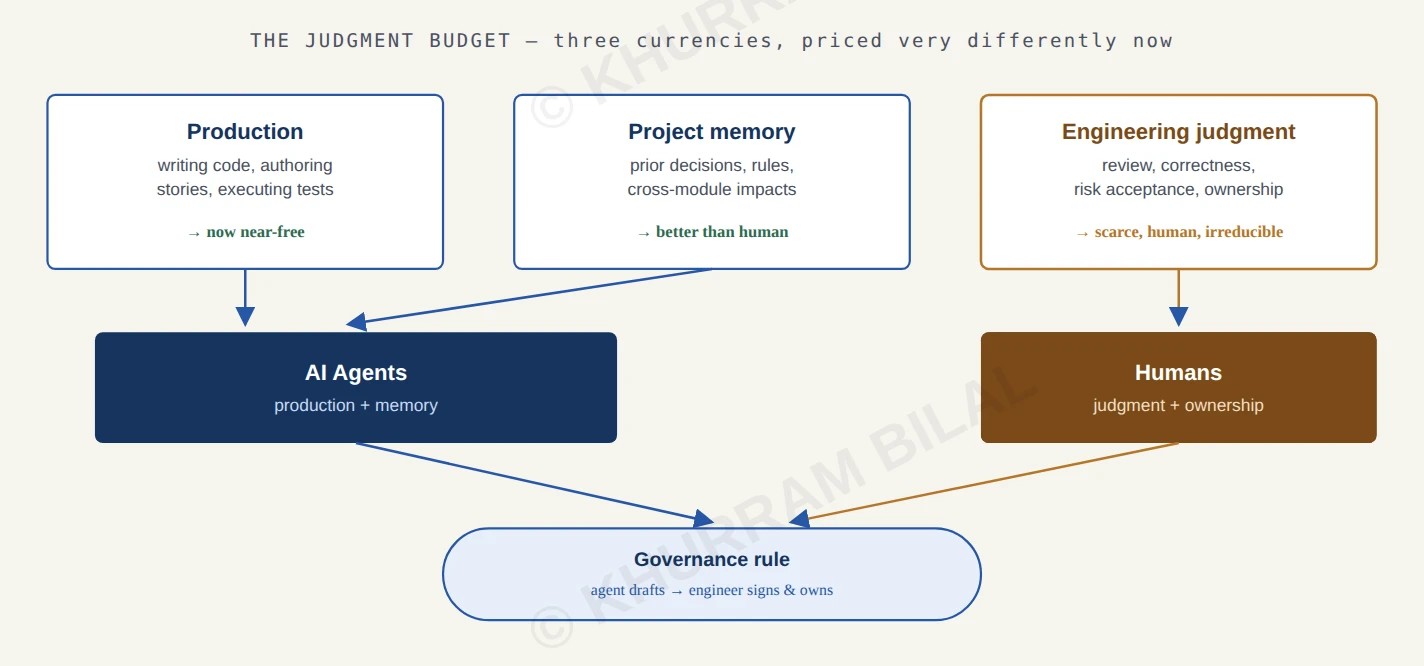
The agent drafts; the engineer reviews, signs off, and owns. No agent output enters the baseline – code, story, test case, or test result – without named human review.
- Development: AI coding agents generate implementation, configured with house conventions. The engineer reviews, corrects, commits – and owns the commit.
- Requirements: a story-authoring agent drafts impact-aware stories in minutes. The BA reviews and signs off every one before baseline.
- Test design & execution: an agent recommends coverage; QA reviews and locks it. An execution agent runs the first cycle in minutes; QA validates every finding.
Requirement gaps, not bugs
This is the model’s most fragile component, and it isn’t a tool – it’s a classification.
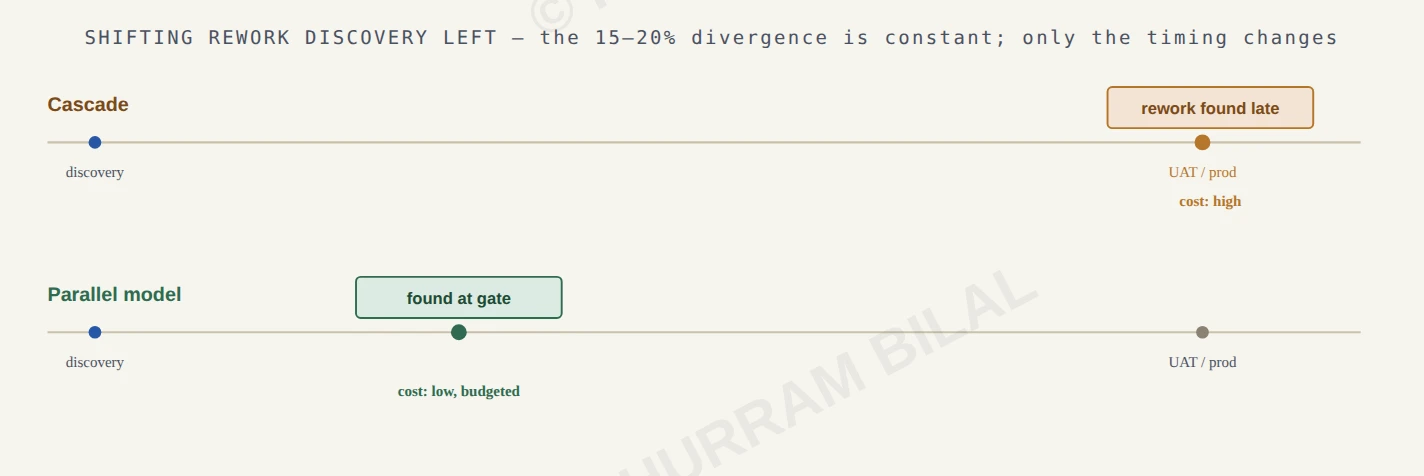
By the gate, verification surfaces exactly where the build diverges from the signed-off requirement. The default instinct is to log every mismatch as a defect – and “defect” carries an accusation: the developer erred against a known truth. But nobody erred. The requirement evolved during elaboration – which is what requirements do. So the rule instead: these findings are logged as requirement gaps, not defects. Same ticket, same fix, completely different organizational meaning.
The entire parallel model depends on developers being willing to start before full sign-off. Log every convergence mismatch as a defect, and a rational developer learns not to start until everything is signed. Early starting dies quietly, and the “parallel model” gets slower every quarter while every ceremony continues.
Why partial adoption fails: the interdependence loop
These three elements – parallel structure, AI augmentation, and the requirement-gap culture – are not a menu. They’re a dependency loop.
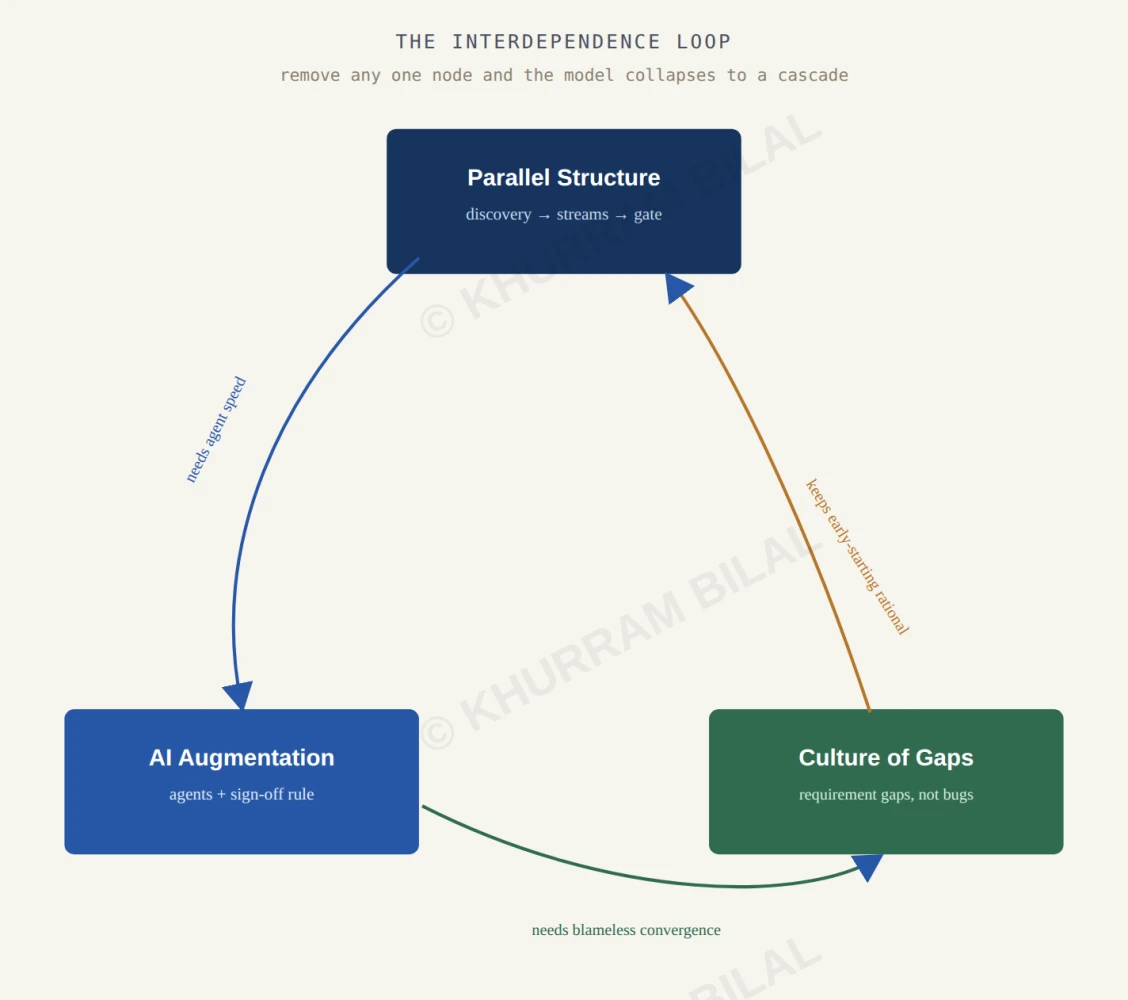
The trap teams walk into monthly: license coding agents but keep sequential phases (marginal gains, “AI coding is overhyped”). Parallelize workstreams but keep logging convergence findings as defects (morale collapses, “parallel delivery creates chaos”). Automate test execution without human validation (a false pass slips through, “you can’t trust AI testing”). Each team benchmarked a component, not the system.
How to adopt it, and what it delivers
Implement the complete model on one team and one engagement:
- Configure agents with house conventions and project context, upfront.
- Declare the requirement-gap classification before the first gate, publicly, from leadership.
- Enforce gate discipline from cycle one – no handover without signed requirements and locked tests.
- Measure the system, not the components – elapsed time from discovery session to functional application in the client’s hands.
Run in production, the results have been consistent: client-demonstrable working frontends within days of discovery, requirements authoring compressed from days to a review cycle, 40–50% effort reduction across test design and execution, and convergence rework held inside a predictable, budgeted 15–20% band.
Production is nearly free. Memory is better held by agents that never forget and never resign. Judgment – only judgment – remains scarce. Teams that reorganize around that allocation stop waiting on anyone. For once, everyone else is waiting on them.
© 2026 Khurram Bilal. All rights reserved.

Fractional CTO, Tech Sprinter
LinkedIn →Want to talk through this for your company?
We work with a small number of startups and scale-ups at a time. If this resonated, let's have a conversation.
Send a message