The Joint Discovery Session: Why Five Perspectives Beat One Requirements Document
Why five disciplines in one discovery session beat a requirements document: contradictions surface while they are still cheap to resolve, not after build.
A requirements document captures what one professional lens notices. A joint discovery session lets five disciplines hear the client firsthand—and reveal ambiguity before it becomes rework.
Episode 2 of the AI-Augmented Parallel SDLC series. The pillar article introduced the full model: discover once, run three workstreams in parallel, and converge at one quality gate. Episode 1 explained how queues and lost context create handoff debt. This episode shows how to remove that debt at intake.
The idea in 30 seconds
- One conversation: the domain expert, BA, designer, developer, and QA attend together.
- Five lenses: each person records what their discipline is trained to notice.
- One outcome: contradictions surface while they are still cheap to resolve.
In this article
- Why documents lose context
- How five roles hear one sentence
- Why disagreement is useful
- How AI organizes the notes
- The economics
- A six-step protocol
Most software delivery methods begin with the same quiet assumption: someone interviews the client, then writes the document everyone else will work from.
We have spent decades polishing that ritual: better templates, stricter sign-offs, and more elaborate traceability. All of it optimizes the artifact. Very little of it questions what the artifact removed.
The more useful question is not “How do we improve the requirements document?” It is “Why does one document have to mediate the conversation at all?”
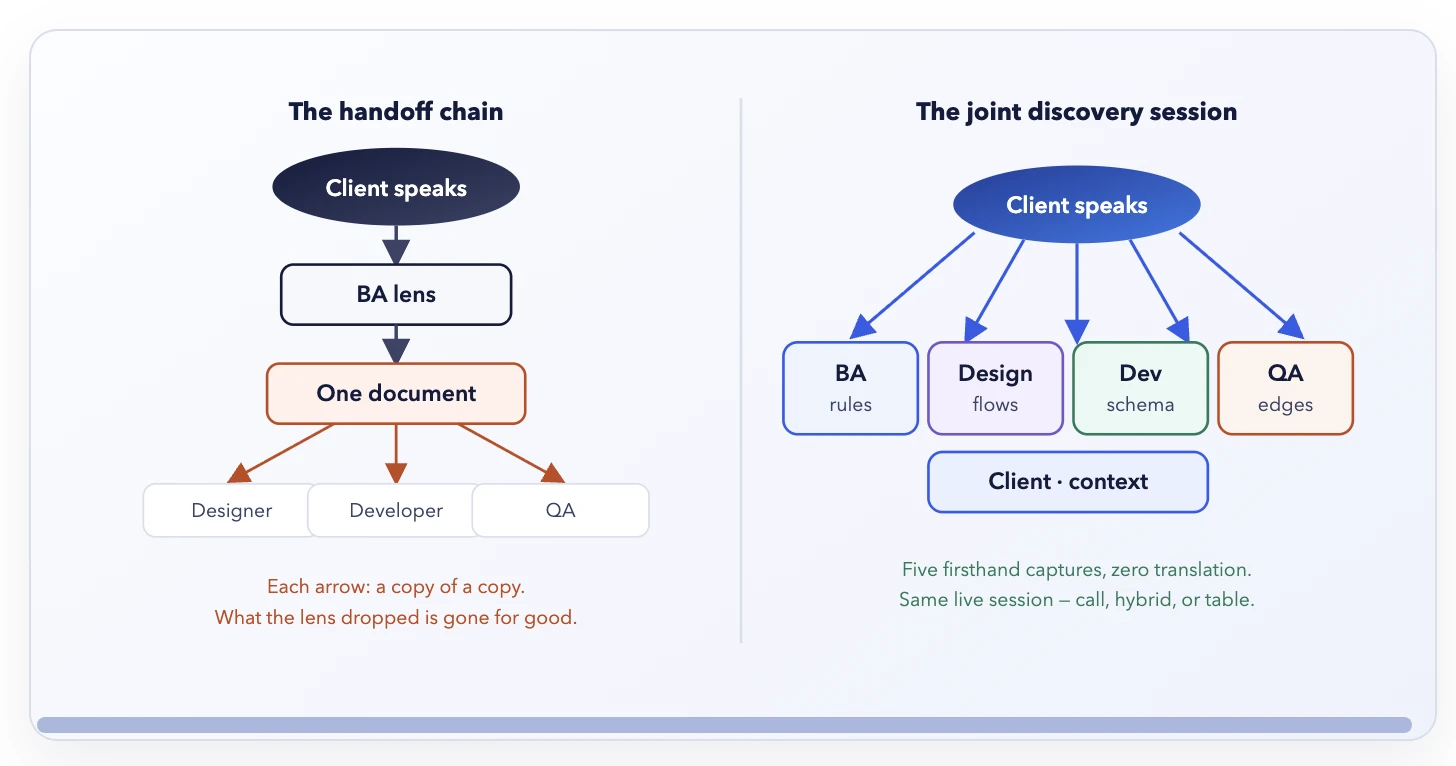
The inherited answer is “so everyone shares the same understanding.” In practice, the document replaces several firsthand understandings with one secondhand summary—and distributes that compressed version through the team.
A joint discovery session removes that filter. The domain expert, BA, designer, developer, and QA join one live conversation under a simple rule: every discipline captures its own notes through its own professional lens. No master scribe and no “definitive” summary. Five perspectives, one source.
This is not about putting everyone in the same room. A remote or hybrid session works just as well. What matters is simultaneous, firsthand access: every discipline hears the same words, can interrupt, and can ask the question its craft makes visible. A recap, recording summary, or requirements document cannot recreate that moment.
Five sets of notes may sound like duplication. They are not. They are coverage.
A requirements document is a lens, not a record
The first fidelity loss in requirements engineering does not happen during a handoff. It happens at capture.
When a BA listens to a stakeholder, they naturally filter for business rules, entities, and scope boundaries. That is expertise, not negligence. But the resulting document is still a projection through one professional lens. What falls outside that lens is not mistranscribed; it may never be captured.
Then the projection is projected again. The designer extracts screens, flows, and states from text that may have lost spatial nuance. The developer derives data contracts from the resulting interface. QA reconstructs expected behavior from all of it. Compression stacks on compression.
It is the semantic telephone game—and the first loss can occur before the first handoff.
A document authored by one discipline can only capture what that discipline was trained to see. No review cycle can validate what was never recorded.
One sentence, five professional readings
Consider one sentence an operations lead might casually mention during discovery:
“Users can usually edit an invoice after it’s sent.”
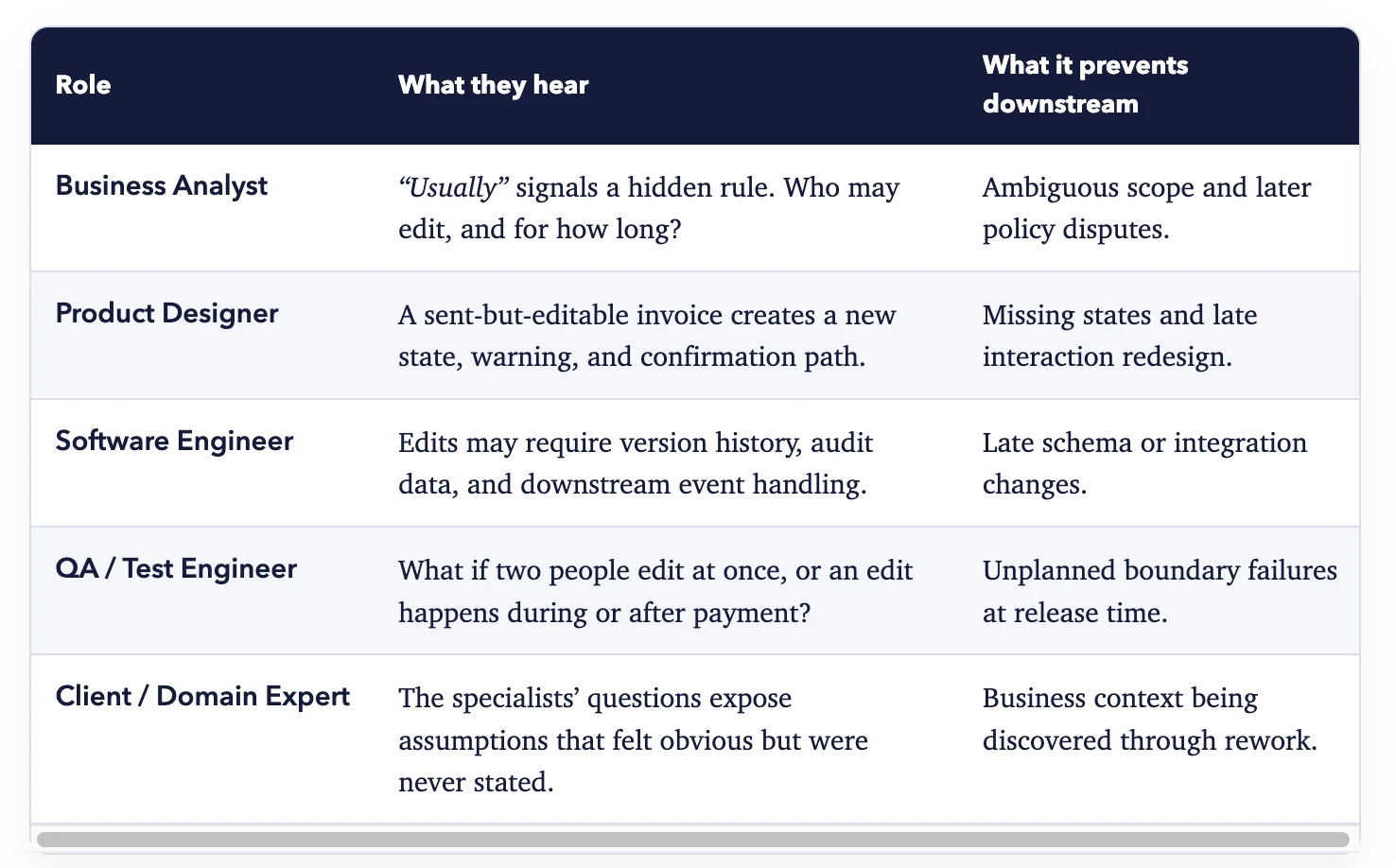
It sounds harmless. Yet each specialist hears a different risk because each discipline is trained to find a different class of problem:
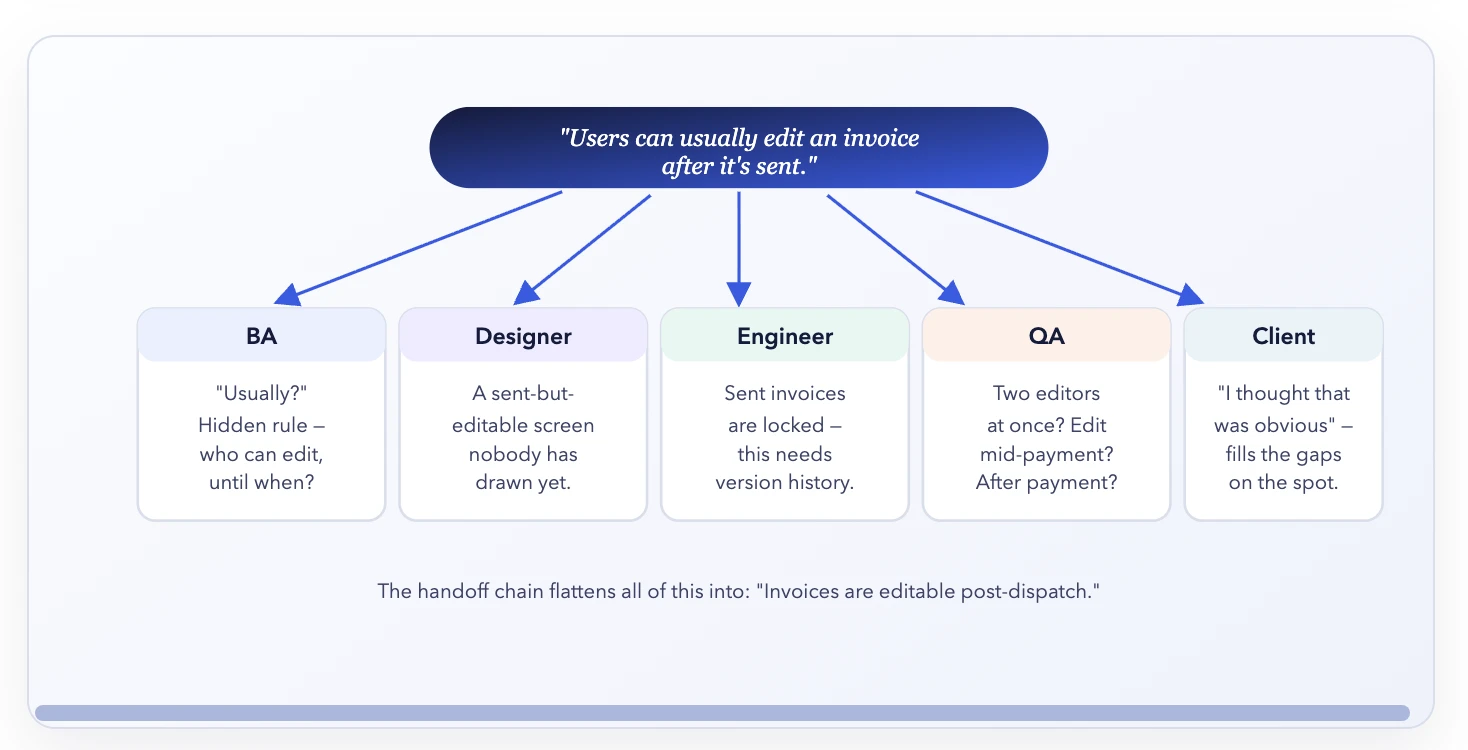
In a sequential chain, that discussion rarely happens at once. The sentence is flattened into one line—“Invoices are editable post-dispatch”—while the unanswered questions reappear later as change requests, redesign, schema rework, or defects.
In a joint session, the team can unpack the sentence while the domain expert and the original context are still present.
The discrepancies are the deliverable
The obvious objection is that five sets of notes will contradict one another.
They will. That divergence is not a failure mode; it is useful evidence.
If the engineer writes “edits create an immutable version” while the designer writes “edits update fields in place,” the session did not create a conflict. It exposed an architectural contradiction that already existed—early enough to resolve it in minutes with the client present.
A sequential chain hides that contradiction inside the artifact. Each discipline resolves the ambiguity independently until the interface, API, and test expectations collide during integration.
Divergent notes don’t manufacture disagreement. They reveal misalignment that was already there — while resolution costs minutes instead of sprints.
“Won’t five perspectives create noise?”
Cross-functional discovery does create more questions. The key is that they arrive while the people who can answer them are together—not weeks later in separate review queues.
The alternative is not silence; it is deferred disagreement. When the BA and client work alone, an early workflow suggestion can harden into an approved requirement before technical feasibility, interaction states, or failure modes have been explored.
That is how a business problem quietly turns into a prescribed solution. The client describes a pain point; the BA documents the most visible workflow; and a provisional idea becomes “the requirement.” A developer joining later may recognize a much simpler native capability, but by then the longer path has scope, screens, and sign-off attached to it.
By the time the document reaches development and QA, challenging the path can feel more expensive than building it. The developer reads it and thinks:
“Are we solving duplicate payouts, or do we need an auditable record of who authorized them? If it is the latter, an event log and notification may replace this four-step form.”
Asked live, that question can save a backlog. Asked after sign-off, it can trigger re-education, redesign, and a formal change request. Many teams take the path of least resistance and build what was written.
What useful interruption looks like
Put design, engineering, and QA in the same live session as the client, and the dynamic changes:
- Engineering tests the proposed mechanism. The developer separates the business outcome from the suggested implementation and offers a simpler route where one exists.
- Design exposes invisible states. The designer asks what a person sees before, during, and after an exception—not only on the happy path.
- QA defines the boundary. For a “simple batch upload,” QA asks: “If row 4,000 of 10,000 fails, do we roll everything back or process the clean rows and return an error ledger?”
The facilitator’s job is to keep these interventions short, decision-oriented, and tied to the user or business outcome. The result is not a design-by-committee session. It is faster access to the questions that would otherwise interrupt delivery later.
How AI keeps five note streams usable
Five raw note streams create an obvious operational cost: someone must structure them, preserve their provenance, and compare them. If that work falls back to one human editor, the old bottleneck returns.
This is where AI changes the economics. The pillar article separates each role into three kinds of work: production (drafting the artifact), memory (retaining decisions), and judgment (deciding what is right). AI can lower the effort of production and memory. Judgment—and accountability—stay with named human owners.
- Keep each stream distinct. BA notes can seed user stories, design notes can seed flows, engineering notes can seed contracts, and QA notes can seed test scenarios. The agent drafts; the discipline owner reviews and approves.
- Compare without flattening. A reconciliation pass flags conflicting assumptions across the streams and turns them into a decision agenda. The output is a Reconciliation Matrix, not a new master summary.
- Preserve the source. With explicit participant consent and appropriate access controls, the transcript can retain the rationale behind decisions. A later question can be answered from the original context rather than a thirdhand paraphrase.
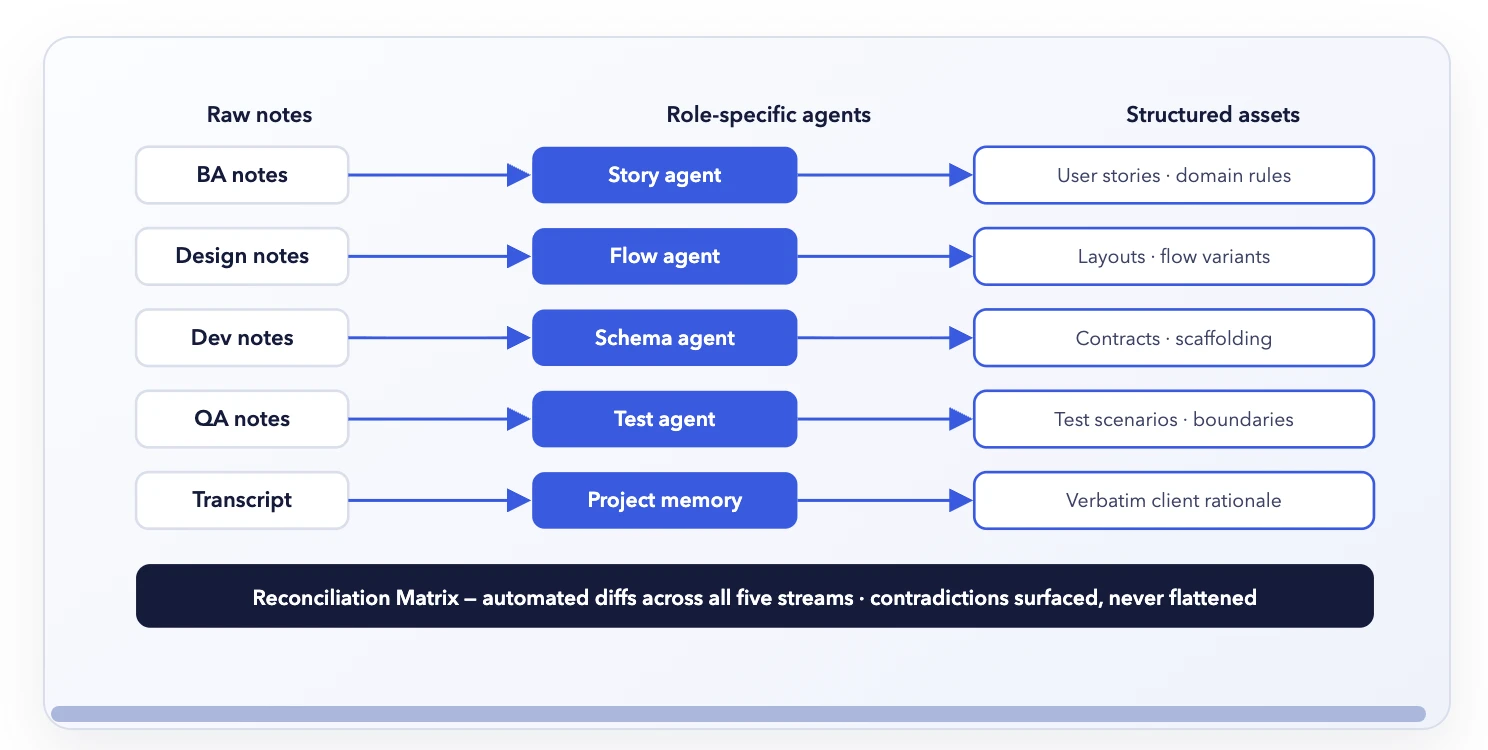
AI does not replace attendance, authorship, or accountability. It makes the five perspectives affordable to maintain. The humans spend judgment in the session; the agents reduce the clerical work needed to turn that judgment into durable, reviewable artifacts.
The economics of cross-functional discovery
The cost objection is reasonable: five specialists in a half-day workshop consume roughly 20 person-hours. The relevant comparison, however, is not a one-person meeting. It is the end-to-end cost of sequential clarification.
Compare the two paths:
- Joint discovery: about 20 person-hours invested up front, followed by immediate discipline-specific work.
- Sequential discovery: interviews, drafting, reviews, clarifications, and handoffs spread across calendar time—while downstream roles wait or work from partial context.
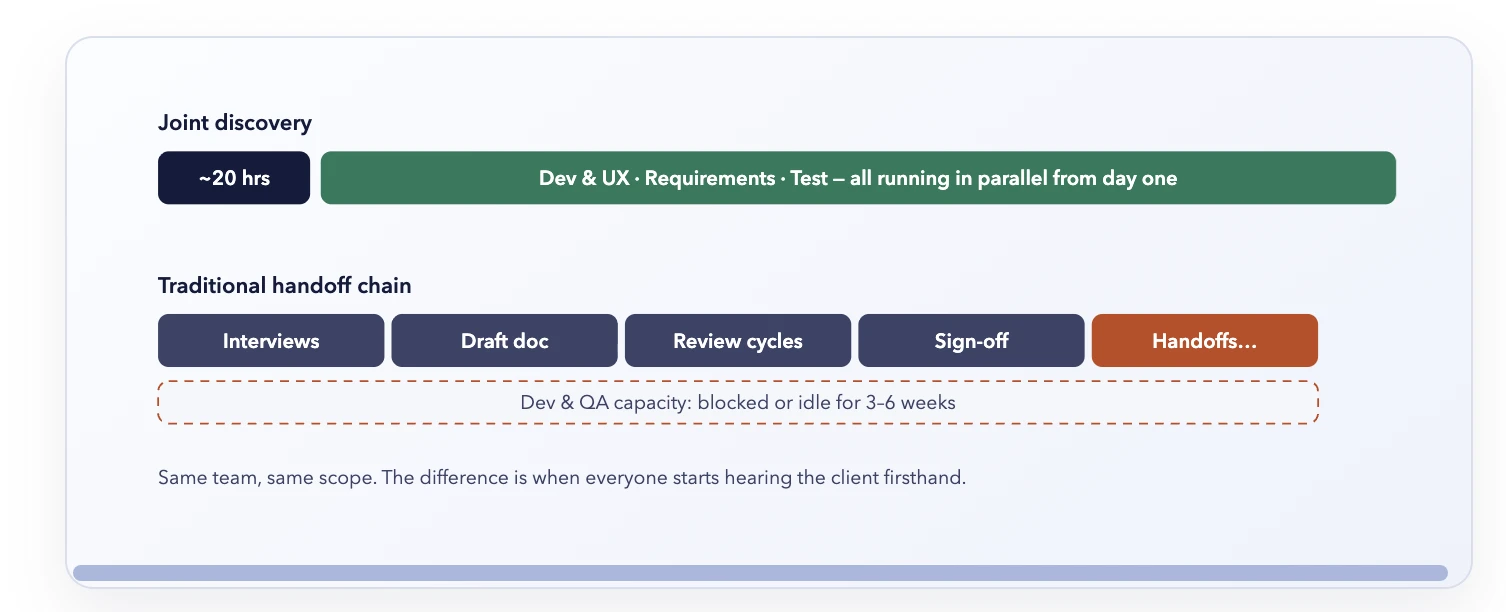
Your numbers will vary, so measure them. Track time from the first discovery conversation to the point when development, design, and test preparation can all begin. Then add the hours spent clarifying or rebuilding misunderstood behavior. That is the real baseline.
Beware the consolidation reflex
A common regression appears a few sprints in: a well-meaning lead asks the BA to “clean up” the separate notes into one definitive master document.
That restores the single-lens bottleneck. Keep a shared decision log, but preserve the source and owner of each perspective. Alignment should happen through explicit reconciliation and quality gates—not by crowning one set of notes as the only truth.
How to run your first joint discovery session
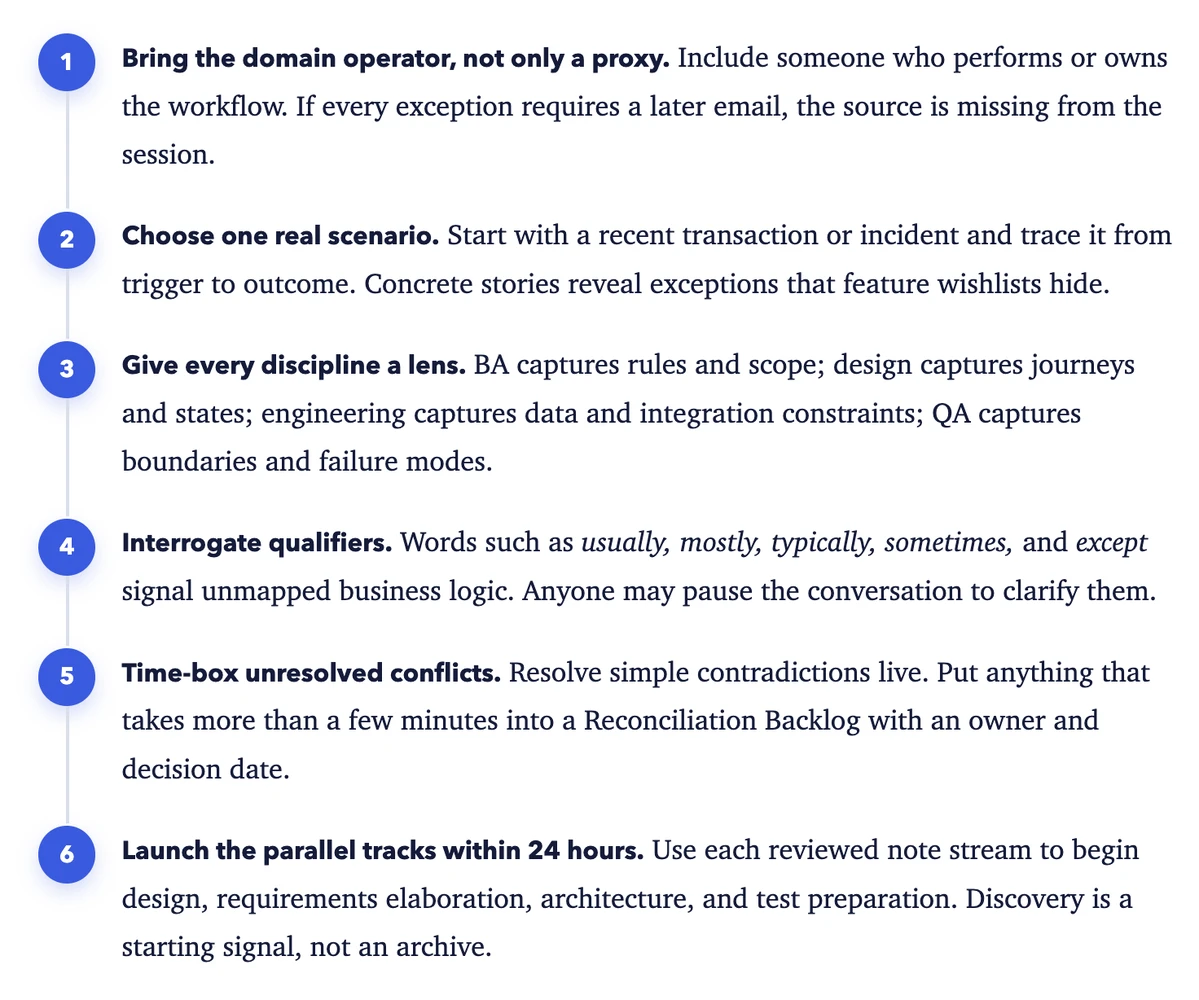
Pilot it without changing your whole process
Choose one medium-sized feature with real domain complexity. Run one 90-minute joint session, preserve the five note streams, and compare the next two weeks against a similar feature. Measure clarification loops, blocked days, late scope changes, and rework—not meeting sentiment.
The best handoff is the one you remove
The joint discovery session removes the most damaging handoff: the one between the client’s intent and the people who must design, build, and test it. Every key discipline hears the same source, asks its own questions, and leaves with firsthand context.
You still need durable artifacts. What you do not need is a single perspective pretending to be the entire truth.
One set of notes is a summary. Five professional perspectives create coverage—and make the missing decisions visible.
In this series
The AI-Augmented Parallel SDLC — the full blueprint: discovery once, three parallel workstreams, one gate.
Episode 1: The Handoff Chain — Why Your Team Is Mostly Paying Handoff Debt
Next up — Episode 3: The Three Parallel Workstreams: How Development & UX, Requirements, and Test Launch Simultaneously on Day One Without Collision.

Fractional CTO, Tech Sprinter
LinkedIn →Want to talk through this for your company?
We work with a small number of startups and scale-ups at a time. If this resonated, let's have a conversation.
Send a message