The Handoff Chain: Why Your Team Is Mostly Paying Handoff Debt
Well over half of a feature lead time is queue time, not build time. How handoff debt accumulates, and why tightening the chain never removes it.
Episode 1: The AI Augmented Parallel SDLC
Audit a delivery pipeline honestly. Not the Gantt chart, the actual clock.
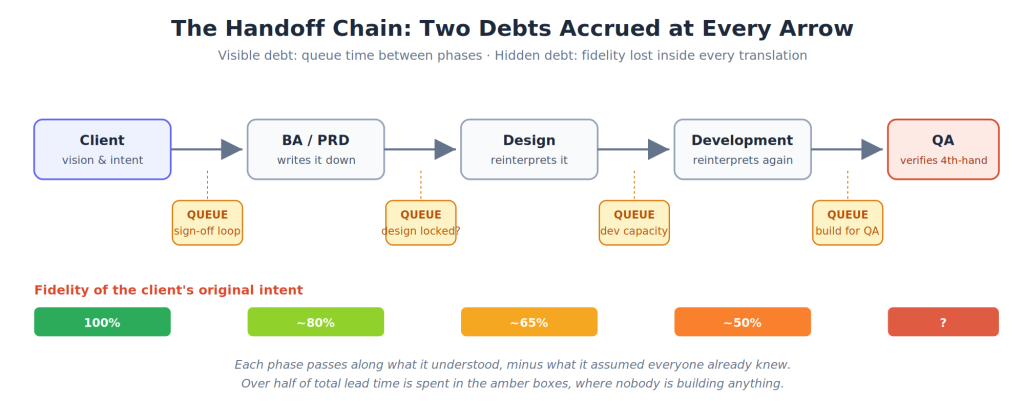
What you find is uncomfortable: most of a feature’s lead time isn’t spent building the feature. It’s spent between people. The PRD sits in a review queue. The Figma file waits for sign-off. The build waits for a QA slot.
Lean practitioners have measured this for decades and the number barely moves: well over half of total lead time, often 70% or more, is queue time. Nobody is working on the thing. Everybody is waiting for permission to.
We ran a chain like that for years. And for years we did what most delivery organizations do: tighter SLAs, better templates, more detailed tickets, one more sync meeting. It took us embarrassingly long to notice we were tuning the chain when the chain itself was the problem.
The handoff debt is really two debts, and only one of them shows up on the books.
The first debt: the queue trap
The visible debt is idle time. Every discipline’s start condition is someone else’s finish condition, and the blocking isn’t partial. It’s total.
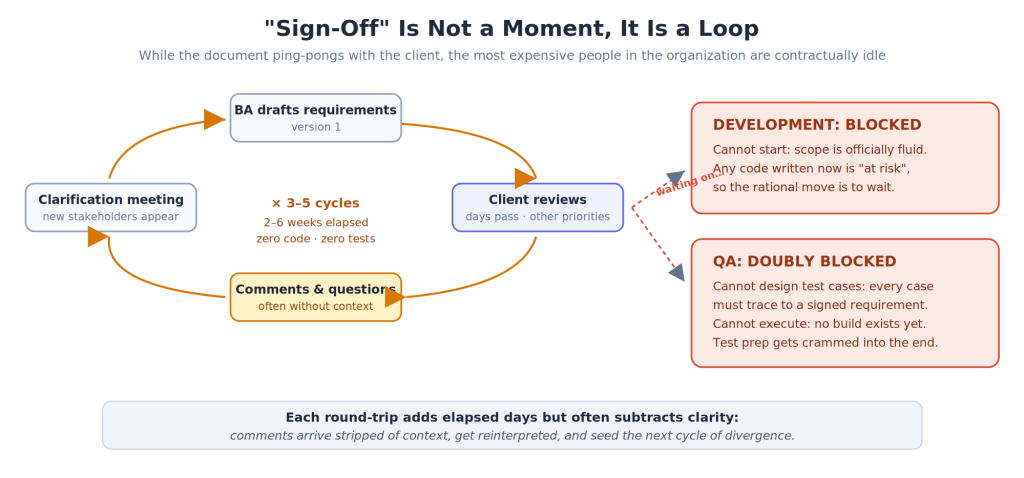
Watch what each seat is doing while “requirements sign-off” is in progress:
- Development can’t start. Scope is officially fluid, so any code written now is “at risk.” The rational move is to wait.
- QA is blocked twice over. Every test case has to trace to a signed requirement, so QA can’t design a single case, prep test data, or build automation scaffolding. And even after sign-off, they can’t execute anything until a build exists.
So test prep, which should be the most thoughtful work in the pipeline, gets crammed into the final weeks under deadline pressure. Meanwhile the most expensive people in the organization spend the front of every engagement contractually idle.
And sign-off isn’t a moment. It’s a loop.
Draft one goes out. The client takes days to review; they have a business to run. Comments come back stripped of context. A clarification meeting gets scheduled. New stakeholders show up with new opinions. Version two goes out. Three to five cycles of this is normal, and every round-trip adds elapsed days while often subtracting clarity.
We’ve watched two to six weeks pass this way. Zero code, zero tests, an entire team parked behind a document playing ping-pong.
Here’s the part that took us longest to accept: none of this is a discipline problem. The queue isn’t caused by anyone underperforming. It’s a structural property of serialized work. Toyota figured this out on factory floors seventy years ago. Batch handoffs are the waste.
You cannot manage your way out of a queue that your process is designed to create. You can only redesign the process so the queue never forms.
The second debt: the semantic telephone game
The hidden debt is worse, because nobody logs it. Every handoff is a translation, and every translation loses something.
Client intent becomes a BA document becomes screens becomes code. By the time QA verifies the build, they’re verifying a fourth-hand account of what the client actually meant. And the mismatches get filed as “bugs” against a developer who faithfully built exactly what the document said.
What decays isn’t the happy path; everyone remembers the happy path. It’s the material nobody wrote down because it felt obvious at the time: the edge cases, the validation rules, the reason a constraint exists at all.
Three handoffs later, the assumptions are the requirements.
We’ve known this for 70 years. Why is it only fixable now?
Nothing in the diagnosis is new. Concurrent engineering attacked serialized phases in the 1980s. Lean software named queue time as waste in the 2000s. The Agile manifesto was written against handoffs. So why did the chain survive every reform?
Because every reform attacked the process while the cost structure underneath stayed put. Three costs held the chain in place, and no methodology could vote them away:
- Rework was human-priced. Starting before sign-off meant a human might build the wrong thing twice, at full cost. Waiting was rational insurance.
- Parallel scaffolding was manual. Mocks, stubs, contract tests, synthetic data, all hand-built by the same scarce engineers, often costing nearly as much as the real thing.
- Context could only live in people or documents. The BA-as-translator role existed because there was no other storage medium for intent. The telephone game wasn’t a flaw in the chain; it was the chain.
Agile shortened the chain into two-week loops. But inside most sprints the mini-waterfall persisted: signed, then built, then tested. Smaller batches, same physics.
What AI changed isn’t the diagnosis. It’s the arithmetic.
- Agents make production near-free, so a 15-20% requirements divergence flips from budget hole to budgeted band. Starting early flips from reckless to rational.
- Agents generate mocks, contract tests, and test-case drafts in minutes, so the scaffolding that made parallelism unaffordable now costs almost nothing.
- Agents hold project memory that never forgets, never resigns, and never summarizes away the edge case that felt obvious in the moment.
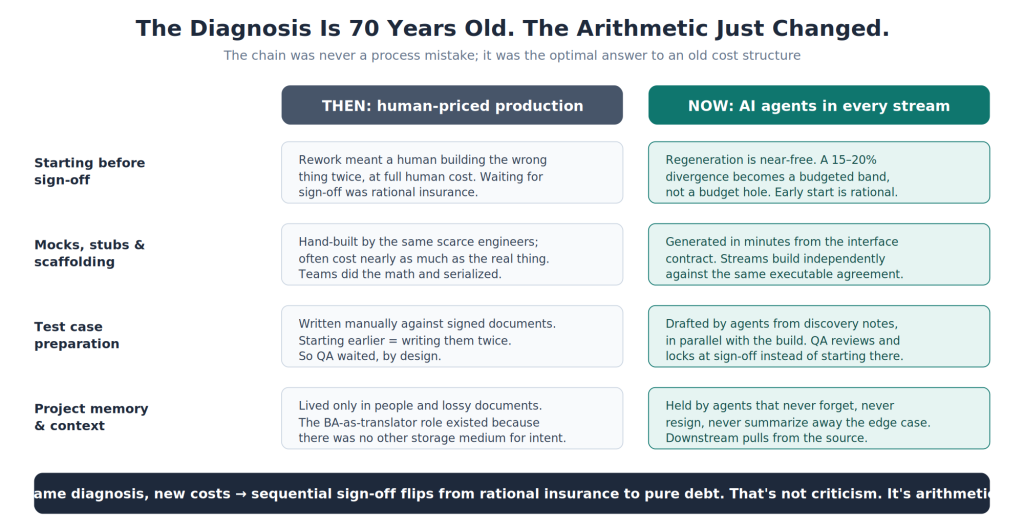
The chain was never a process mistake. It was the optimal answer to an old cost structure. Change the costs, and the optimal process changes with it. That’s not a criticism of anyone running it. It’s arithmetic.
One warning: dropping AI coding agents into an unchanged sequential process just speeds up the 30% of time that’s actual work, while the 70% of queue time sits untouched. Total delivery improves about 15%, and the organization concludes AI is overhyped. They benchmarked a component. The debt lives in the system.
What replaces the handoffs
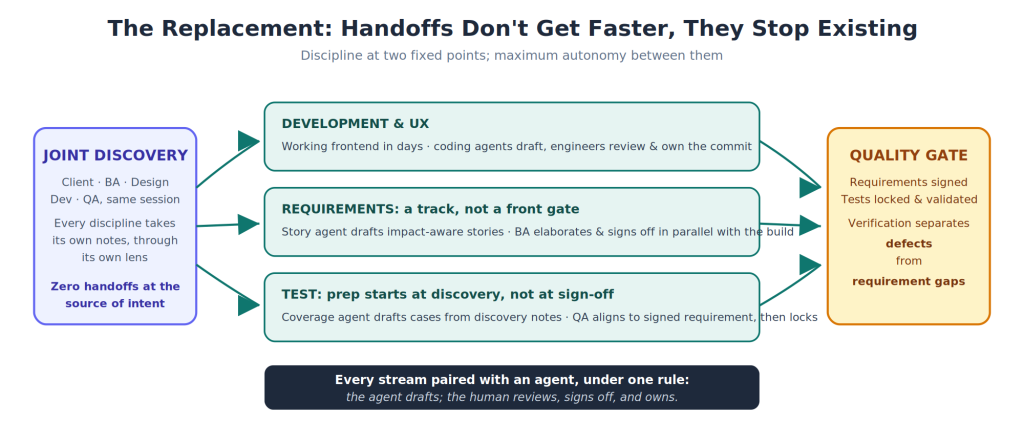
The chain’s front end collapses into one joint discovery session: client, BA, designer, developer, and QA in the same session, each taking notes through their own lens. The designer hears a screen flow, the tester hears an edge case, the developer hears a data model, from the same sentence, firsthand, at the same time. Zero handoffs where fidelity matters most, because everyone was at the source.
Then three workstreams run concurrently:
- Development and UX have a working frontend within days.
- The BA elaborates requirements as a parallel track, not a front gate. The client back-and-forth still happens; it just no longer holds anyone hostage.
- QA drafts test cases from discovery notes while the build is in flight, then aligns and locks the suite at sign-off instead of starting from a blank page.
The handoffs don’t get faster. They stop existing.
The one metric that tells the truth
Flow efficiency: active work time divided by total elapsed lead time.
Most sequential teams, measured honestly, sit at 10-15%. That number is the size of your handoff debt, stated plainly. Story points and velocity all look fine while the system starves in queues. Flow efficiency only moves when the waits between phases die.
The handoff debt compounds in a currency that never appears on a timesheet: elapsed time and lost meaning. The teams that escape it aren’t the ones who made their handoffs faster. They’re the ones who made their handoffs unnecessary.
This is Episode 1 of a series on the AI Augmented Parallel SDLC. Next up: the Joint Discovery Session, and why five people taking five different sets of notes from one conversation beats any document ever written.
What’s your team’s flow efficiency, honestly?
Leasrn more: https://www.tech-sprinter.com/blog/the-ai-augmented-parallel-sdlc

Fractional CTO, Tech Sprinter
LinkedIn →Want to talk through this for your company?
We work with a small number of startups and scale-ups at a time. If this resonated, let's have a conversation.
Send a message